Waiting for the ice
Churchill sits on the western shore of Hudson Bay. For a few weeks every October and November, it's one of the best places on the planet for polar bear watching.
It's all about the ice. Polar bears hunt seals from the frozen sea. When Hudson Bay melts each summer, they're stranded ashore, living off their fat until it freezes again. The coast around Churchill is one of the first places to freeze, so this is where they come to wait.
We arrived in the thick of it. Days hovered around zero and nights fell to minus 10°C. One day brought bright sunshine, the next brought snow. The lakes were freezing over, the tundra pools were thick with slush, and the first fringe of ice was creeping along the shore. Our guides told us that when the bay finally freezes, the big males can be gone within hours, with the mothers and cubs following on behind.
Knowing that made every sighting feel precious. The bears weren't just there. They were waiting, and in a way, so were we.
Into another world
There's no road to Churchill. You fly in or you take the train, and the flight north from Winnipeg is worth staying awake for. Farmland gives way to forest, the forest breaks up into lakes, and the lakes turn whiter as you head north. Eventually, there's nothing below you but tundra.
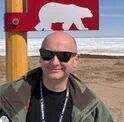
Churchill is home to fewer than 900 people, and it's very much the bears' town. There are warning signs everywhere. There's even a polar bear holding facility, the 'polar bear jail', where bears that wander too close are kept until they can be moved safely away. A bear had been seen nearby when we visited, so we were kept firmly between the van and the building. Nobody needed telling twice.
We packed a lot into our time in town. We visited the Parks Canada museum at the railway station and Polar Bears International's visitor centre. We also saw Miss Piggy, a Curtiss Commando cargo plane that crash-landed on the rocks outside town. Nobody was hurt, but the wreck is a reminder of how rugged life in this frontier town was until surprisingly recently. Florence Hamilton, a Sayisi Dene elder, gave us a talk on the Indigenous communities of Hudson Bay that I could have listened to for hours. And everywhere you turn there are murals, huge and colourful, telling the life, legends and wildlife of this one-of-a-kind community.
It was also Halloween. Churchill takes it seriously, with decorations all over town. Not one person, though, was dressed as a polar bear. I suspect that's a joke that wears thin pretty quickly round here.
Then came the dog yard. The first thing we saw was a woman chopping meat with an axe for a yard full of ecstatic huskies. We were definitely not in the suburbs any more, and a very long way from the nearest pet food shop. Our host was Dave Daley, a renowned Métis musher and storyteller who founded Wapusk Adventures and the Hudson Bay Quest sled dog race. His stories of the frozen country north of town had us spellbound. Sadly, at around zero it was too warm for the dogs to run, as they like it nearer minus 10°C. Nobody seemed to have told the huskies.
Then, on a drive out of town that first evening, we saw our first polar bear. We watched it for half an hour, and I'll admit to goosebumps. I've seen countless documentaries, but nothing prepares you for the real thing. That huge, creamy shape moved through the undergrowth completely unhurried and completely at home, and it wasn't the least bit interested in us. The next afternoon, on the road to the port, we came across a mother with two cubs. I was starting to think this might be quite a trip.
A lodge on another planet
We headed out to Tundra Buggy Lodge as the sun went down. It's an hour and a half from the dock, first along old military roads and then out across frozen tundra, slush-filled pools and ice heaves, with the last of the light fading over the bay. Tundra Buggies are giants on enormous tyres, and they lurch over the terrain at angles that look alarming and feel worse. Our driver didn't bat an eyelid. By the time we arrived, it was dark.
Our buggy was electric, part of Frontier North's commitment to phasing out its ICE fleet, and glided surprisingly quietly over the frozen landscape. Life on board is surprisingly comfortable. It's warm, with plenty of seats (and a toilet), and hot drinks, snacks and lunch are all served on board during your long day out on the tundra and costal flats. At the back is a large open viewing platform, where you can stand in the crisp air with a polar bear just below you, completely safe. Not just anyone can come out here, either. Access to the bears' habitat, in the Churchill Wildlife Management Area and Wapusk National Park, is carefully monitored, with only a limited number of buggies allowed in and clearly defined areas where they can go.
Here's what nobody quite prepares you for. From the moment you board the buggy at the dock to the moment you step off it back in Churchill, your feet never touch the ground. The lodge is a string of long modules on giant wheels, and the buggies dock against it like shuttles at a space station. Guests, bags, food, water and waste all come and go the same way. Out on the tundra, the buggies sometimes pull up side by side to pass supplies across. Even distance plays tricks on you: a huge boulder on the horizon turns out to be a pebble when you reach it. It's the closest I'll ever come to visiting another planet.
And waiting outside when we docked? Two polar bears. We hadn't even unpacked.
Then there was the food, at Dan's Diner, which was outstanding. Our chef, Claire, is a rising culinary star who has worked alongside chefs in some of the world's finest restaurants, who personally introduces and sets the scene for every course. She cooks with locally sourced ingredients, freshly foraged fruit and herbs, and her own ferments and pickles. We ate beetroot salad, courgette hummus and steelhead trout with rosehip vinegar, with carefully paired wines, in the middle of nowhere, with polar bears outside the window.
The lodge itself is cosy. You sleep in bunks in sleeper-train-style cabins, and every bunk has its own window. That means you can lie in bed and watch for bears, or for the northern lights. I did both.
That first night, the sky put on a show of its own. We watched the northern lights from the rooftop viewing platform, ribbons of light rippling over the tundra. After midnight, when the aurora really got going, the staff came round and gently woke us so we wouldn't miss it. Standing up there in the cold with the whole sky moving above us is something I'll never forget. The next morning, the lodge was full of grown-ups as giddy as children on a school trip, all desperate to get back out to the bears.
Bears doing bear things
And the bears just kept coming. On our first full day out on the tundra I counted at least 15 different bears, maybe 25. After that I gave up counting and just watched.
Some padded alone across the snow. Some were curled up asleep on the beach. Two spent ages right beside our buggy. There were mothers with cubs, and young males squaring up to each other as if about to spar. At one point a pair of curious young males wandered towards a mother and her cubs, and the family ran off across the tundra to keep their distance. And there were bears doing absolutely nothing at all, which turned out to be every bit as fascinating.
Some were already testing the new ice along the shore, spreading their huge paws wide to share out their weight. One youngster took a break from sparring with a friend to rear up and pound the ice with its front feet, again and again. It looked a lot like a rehearsal for breaking through to a seal.
What really got me was the silence. On the buggy we were asked to open the heavy windows gently when viewing and to keep our voices down. When a bear was right below the viewing platform, we weren't to talk or move at all. So, there we were, a group of thrilled grown-ups trying desperately to keep still. Beneath us was one of the most powerful predators on Earth, and it made no sound whatsoever.
Our guide, Mark, is a wildlife expert and a professional photographer. His tips were a real bonus, even though this wasn't the dedicated photography trip. Then there was Bob. He has been out on the tundra for 25 years and has a bear story for every rock and pond, from Gordon Point to a spot he calls No Pants Lake. Plenty of them had the whole buggy laughing. I won't spoil No Pants Lake. You'll have to ask him yourself.
The science of the wait
What set our trip apart from most Churchill polar bear tours was the science. On the Conservation Journey, scientists from Polar Bears International travel with you. We'd already met Kayla McCurry, PBI's Conservation Outreach Manager, at its Churchill visitor centre. At the lodge we were joined by Amy Cutting, PBI's Vice President of Conservation, and Dr Flavio Lehner, its Chief Climate Scientist and an associate professor at Cornell University. Their evening talks gave everything we'd seen during the day a whole new meaning.
We learned how completely the bears depend on the sea ice, and how long they go without food when it's gone. A pregnant female can go up to eight months without eating while she dens, gives birth and feeds her cubs. She does it all on the fat she built up hunting seals the winter before. In Western Hudson Bay, fewer females are now becoming pregnant. Nobody lectured us, but the logic was hard to escape: a shorter ice season means a longer wait, and a longer wait means hungrier bears.
The Arctic foxes have their own worries, with red foxes moving north to compete for food and territory. We'd already watched one fox polish off a lemming, found a fox den and spotted a snowy owl, so it all felt very close to home. We also got a peek at PBI's outreach work. Amy recorded a piece to camera for one of PBI's live broadcasts, and we heard about the polar bear cams they run with explore.org, the people behind the famous Fat Bear Week.
Sitting in the lodge listening to all this, with bears somewhere outside in the dark, really brought it home.
About Polar Bears International
- Polar Bears International is a conservation charity focused on polar bears and the sea ice they depend on. It was founded on a Tundra Buggy in Churchill in 1992.
- Frontiers North Adventures has supported PBI since 2001 with vehicles, lodge space and funding.
- PBI's research and broadcast vehicle, Tundra Buggy One, hosts its live polar bear cams with explore.org. In 2025 it was replaced with a zero-emission electric version.
- On the Conservation Journey, a PBI scientist travels with the group, and part of each booking goes to PBI's work.
Leaving the tundra
Churchill isn't an untouched wilderness, and it never has been. Indigenous peoples have lived in and travelled across this country for countless generations. The town's history is everywhere, from its museums and murals to the rusting wreck of the MV Ithaca in the bay and the old rocket range where scientists once studied the aurora.
Seeing so many bears was a privilege. Understanding why they were there, and how fragile that wait has become, made it unforgettable.
I came home with a head full of Bob's stories and the feeling of having been somewhere truly otherworldly. If you've ever dreamed of seeing polar bears in the wild, Churchill is the place to do it.
This trip would suit you if:
- you'd rather watch wildlife behave than tick off a list of species
- you're happy with comfortable but simple lodge living, with no stepping outside
- you're curious about the science, which makes the Conservation Journey ideal, though every lodge stay includes expert talks
- you're a keen photographer, as the lodge puts you close to the bears day after day
If you'd like to wait for the ice yourself, explore our Churchill polar bear holidays. Our Canada specialists can help you choose the right one.